How Much is Your Property Worth?
By Lisa Lombardi

As the only Silicon Valley brokerage that we know of with a certified appraiser on staff, DeLeon Realty can provide its clients with much more in-depth insight into valuing a property. In this article, I wanted to share some advice on how to determine how much a property is worth.
There are three approaches to value when appraising a single-family residence (SFR) or a 1 – 4 unit residential/income-producing property: the Sales Comparison Approach, most commonly used when appraising an SFR; the Cost Approach, most commonly used for new construction; and the Income Approach, most commonly used for investment properties. Most appraisals include at least two, and sometimes all three, approaches to value.
The Sales Comparison Approach to value is the most widely used amongst residential appraisers when evaluating an SFR or 1 – 4 unit residential/income-producing property. This approach compares a piece of property with recent sales which display similar features as that property, and the comparable sales are positively or negatively adjusted for their differing features from the subject property.
Sounds simple, right? Not quite. “What do you look for to determine my home’s value?” is one of the most commonly asked questions I receive from homeowners. “Lots of things” is always the answer. There are dozens of features and characteristics of a property that are analyzed and compared to recent sales in the area. Some of the major features are location, lot size, and gross living area (GLA) – living space size.
“Location” isn’t just a property’s address; rather, it covers many aspects. It can cover a property’s positive attributes, like a waterfront lot, or a desirable neighborhood such as Old Palo Alto. It can cover a property’s external obsolescence, such as its location on a busy street, or near an airport. These are considered less desirable, and a negative market reaction can often be found when comparing them with properties that do not suffer from the same adversities. Location can also cover factors that are out of the owner’s control, such as the property’s ownership rights, zoning designation, flood zone, and school districts.
A property’s lot size is another major feature that is compared to sales in the neighborhood, and an appraiser has to consider more than just dimensions. For instance, how much of the land is usable or buildable? Is the lot fairly level, or does it slope steeply from the street? A home’s location on a lot can also affect a property’s market value. For example, when the home is placed closer to the frontage of the property, leaving a larger fenced rear yard, it may be more desirable than the same lot with the home placed closer to the rear of the property. The shape of a lot is also a factor, as several properties can have similar lot sizes yet greatly differing values. A rectangular lot that doubles its frontage in length (100’ x 200’) is more desirable than a longer and skinnier lot with the same square footage.
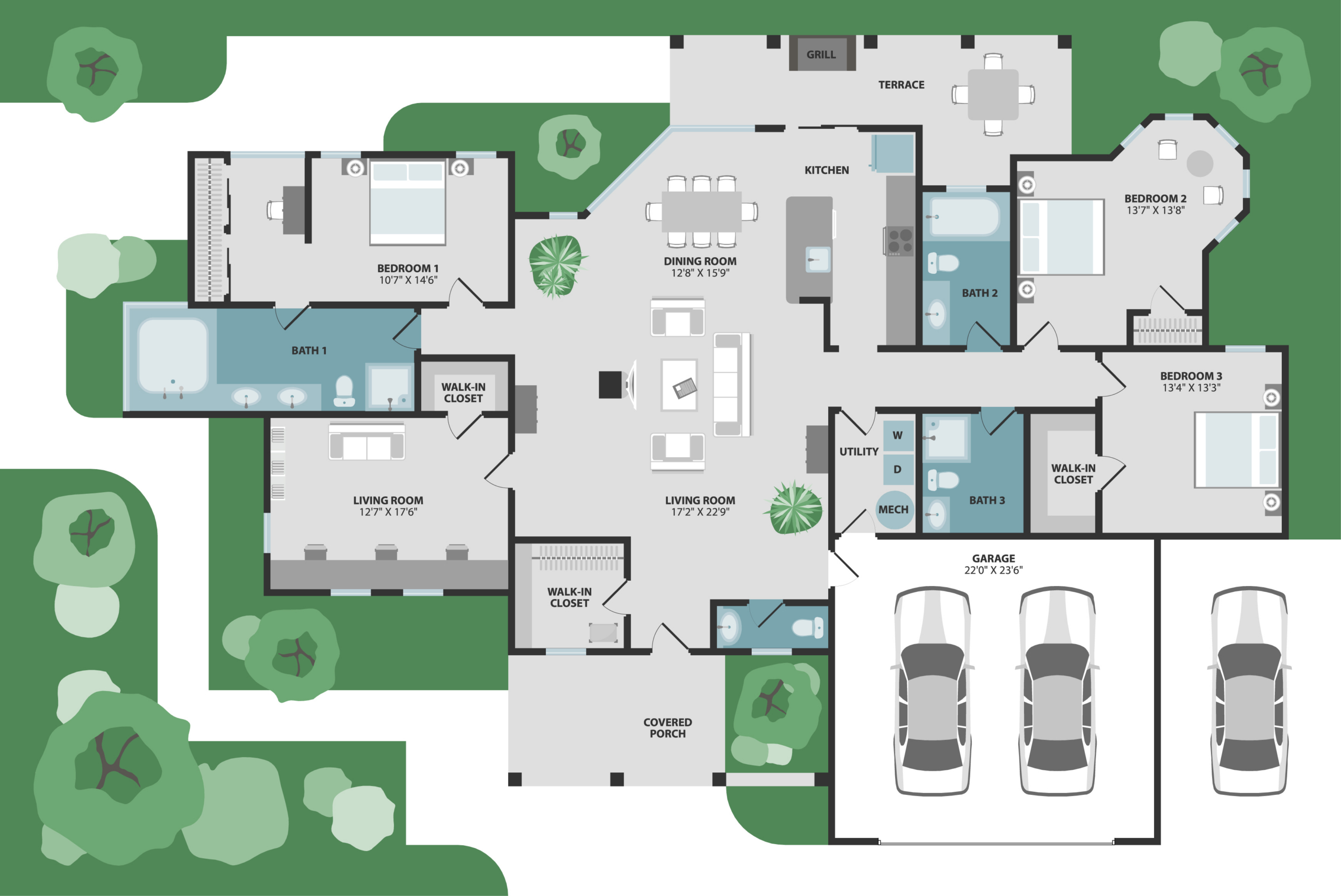
When analyzing the size of a home, there are other aspects to consider besides the amount of living space; for instance, floorplans. Say a home located in Palo Alto, known for its prestigious school district, has a layout with the master bedroom on the first floor and the additional bedrooms on the second floor. This will not be desirable to a couple with young children. Reverse floorplans, where the entry and living areas are on the top floor and the sleeping quarters are on the lower floor, may be considered less desirable than a home with a more traditional floorplan.
Functional obsolescence, defined as “the impairment of functional capacity of a property according to market tastes and standards,” is another important factor that needs to be considered. A large home built with top-of-the-line materials located in a tract neighborhood of smaller homes is considered functional obsolescence, or an over-improvement. An example of an under-improvement may be a 5 bedroom home with only 1 bathroom. Other examples of functional obsolescence can include a bedroom which is accessed directly off the kitchen and also has the only rear exterior door to the backyard, a bedroom within another bedroom, or a house without a bathroom on the first floor.
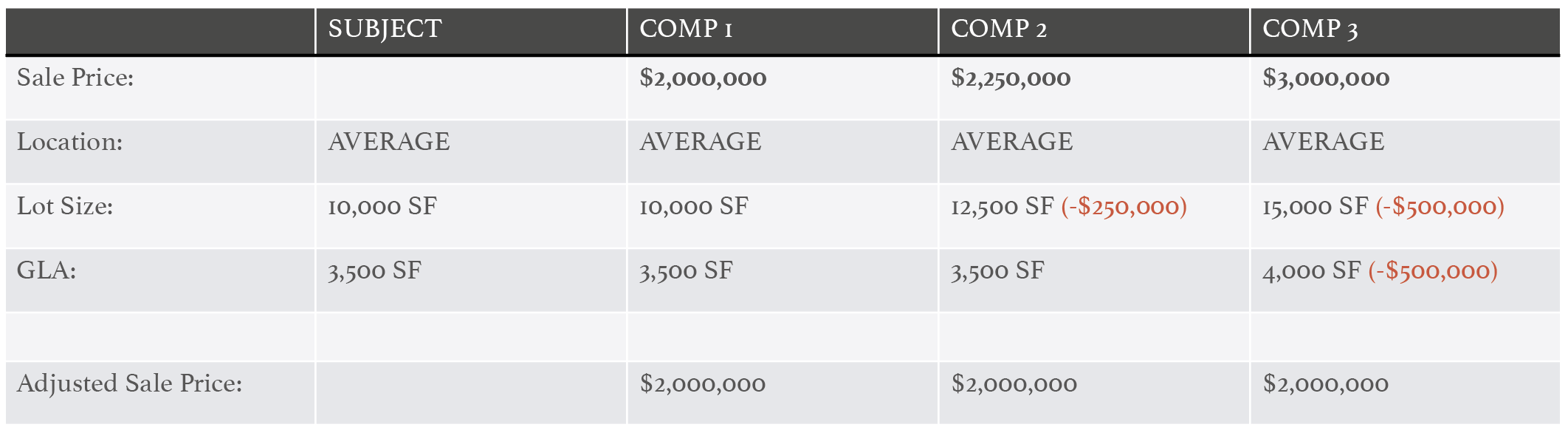
Once recent sales of properties which display similar features as the subject are found, then adjustments to those comparables are made taking into account their differing features from the subject property. Here is a very simplified graph of how the Sales Comparison Approach to value works:
Comparable 1 has the same features as the subject; therefore, no adjustments were applied. Comparable 2’s lot is 2,500 sf larger than the subject’s lot; however, its location and GLA are the same. When I compare it to comparable 1, I can see that there is a market reaction of $250,000 for the difference in lot sizes, and I apply a -$250,000 price adjustment to comparable 2 for its larger lot. Comparable 3 has a significantly larger lot size and a larger GLA. Since I know that there is a market reaction of $250,000 for 2,500 sf of land, I can estimate a -$500,000 price adjustment to comparable 3 for having an additional 5,000 sf of land. Now, comparable 3’s adjusted value is $2,500,000. The subject and comparables 1 and 2 have the same GLA. Comparable 3 has 500 sf more GLA and I can apply a -$500,000 price adjustment to comparable 3. The subject’s estimated market value is: $2,000,000.
Appraising a residential property isn’t as easy as comparing the subject’s location, lot size, or dwelling size with recent sales in the area. If it were, I’d be out of a job!
 Lisa Lombardi is a full-time appraiser for DeLeon Realty. Lisa has been a licensed appraiser since 2002 and a certified appraiser since 2010.
DeLeon Realty, Inc. | DRE #01903224 | Equal Housing Opportunity